Most teams treat marketing personalization at scale as a volume problem: more segments, more sends, more variants. The harder truth is that scale rarely breaks on the number of segments — it breaks on where those segments are defined, who owns them, and how many places the same logic has been copied. By the time a large catalogue and a growing customer base collide with a peak-season calendar, the constraint isn’t creativity. It’s the manual labour of keeping dozens of overlapping segment definitions in sync across tools that were never told they should agree.
This piece is about the architecture underneath personalization, not the campaigns on top of it. Specifically: how to define segmentation once, decide which system holds the source of truth, and let your storefront and your messaging platform consume the same definitions — so adding customers and SKUs doesn’t add a linear amount of manual work.
Why Marketing Personalization at Scale Breaks (and It’s Not the Number of Segments)
The failure mode is quiet. A campaign needs “lapsed VIPs in Ontario who bought outerwear,” so someone builds that audience by hand. The next week, a different campaign needs “high-value customers who haven’t purchased since spring,” which overlaps but isn’t identical, so a second segment gets built. Neither is wired to a shared definition of “VIP” or “lapsed,” so the two drift apart. Multiply that across a year of promotions, and you have a list of Klaviyo segments nobody can audit, several of which contradict each other, and a marketing team spending its hours reconciling audiences instead of designing offers.
The cost compounds because each hand-built segment is also a maintenance burden. Definitions rot as data changes: a segment keyed to a hard-coded date is stale within weeks, and a rule written against last season’s Shopify customer tags silently stops matching anyone. The work of personalization stops being “what should we say” and becomes “which of these forty audiences is still correct.” That is the linear-labour trap, and it is a data-architecture problem before it is a marketing one.
One Source of Segment Truth: Where the Logic Should Actually Live
Before building a single audience, decide which system is the source of truth for each type of segment logic, because the same customer attribute can be computed in more than one place, and having it computed in two places guarantees they will eventually disagree.
Draw the line by data gravity. Order history, fulfillment status, catalogue structure, and customer records live natively in Shopify, so segment logic that depends on them, such as purchase recency, lifetime spend, product-category affinity, B2B company or Markets region, is cheapest to define where that data already sits, using Shopify customer segments and metafields, then synced outward. Engagement and messaging behaviour — email opens, click patterns, SMS consent, flow membership, and predicted metrics such as churn risk and predicted lifetime value — live natively in Klaviyo. So engagement-based segment logic is cheapest to define in Klaviyo, which already ingests the Shopify event stream — orders, checkout events, and product data — and layers its own behavioural and predictive data on top.
The napkin-sketch version: Shopify owns “who they are and what they bought,” Klaviyo owns “how they engage and what they’re likely to do next,” and a defined sync of the native Shopify–Klaviyo integration passing customers, orders, checkout events, and product data is the one seam between them. Personalization logic reads from those two sources. It does not reinvent them inside individual campaigns.
The Fork: Where Granular Segmentation Pays Off, and Where It Just Adds Risk
Every personalization program eventually reaches the same fork, and peak season forces the choice. One path is dynamic segmentation: a small number of live segments defined once and keyed to behaviour and events such as back-in-stock interest, browse-then-abandon, and first purchase in the last 30 days, where the population maintains itself as customers move in and out. The other path is granular static segmentation: many hand-built micro-audiences, each cut for a specific send and each frozen at the moment it was created.
Dynamic segmentation scales sub-linearly. Because the definition lives in one place and updates itself against incoming events and profile properties, adding customers doesn’t add work; the segment that drove a Tuesday flow is the same segment driving the BFCM version, with no rebuild. The trade-off is upfront rigour: you have to model the events and properties correctly, and a sloppy definition propagates everywhere at once.
Granular static segmentation has a real but narrow payoff. When a specific audience carries a specific incremental-revenue hypothesis that a live segment can’t express, a one-off cut is worth it. The trade-off is that every static micro-segment is a standing liability: it has to be QA’d before each send, and it decays the moment the underlying data shifts. At peak season, it multiplies send-fatigue and suppression-logic risk precisely when the calendar is densest, and the margin for error is smallest. Ten bespoke Black Friday audiences are ten things that can misfire on the highest-traffic day of the year, which is why the lead time for this work matters as much as the logic itself.
The defensible position: default to dynamic segments anchored to the single source of truth, and spend your finite granular budget only where a live segment genuinely can’t capture the intent. Granularity should be earned by an expected return, not accumulated by habit.
Automation That Scales Sub-Linearly: Flows Over Campaigns
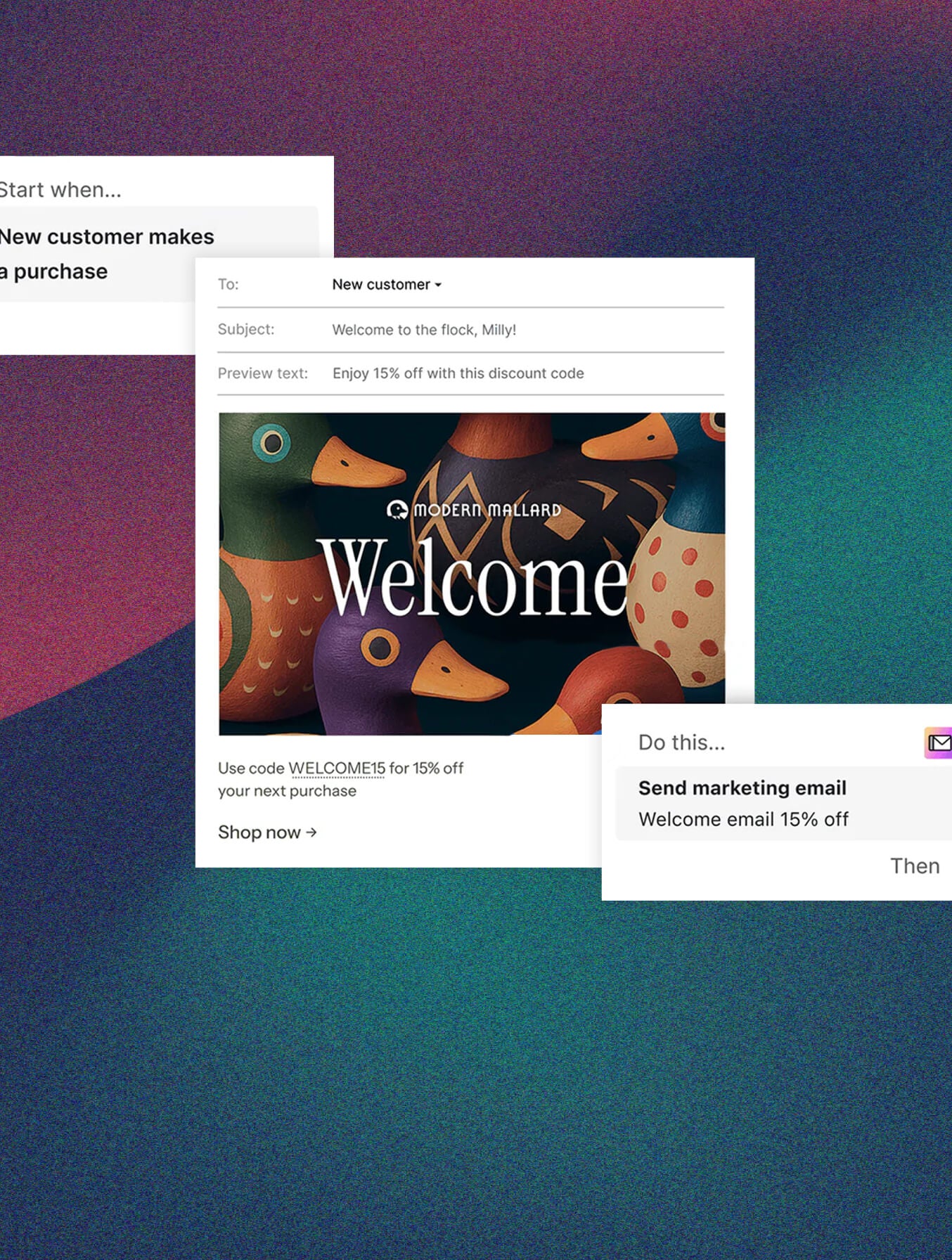
Segmentation architecture only pays off if the automation on top of it is built the same way; defined once, triggered by events, rather than assembled by hand for each send. The distinction that matters here is flows versus campaigns. A campaign is a one-time send to an audience you assembled for that moment; a flow is an automation that runs continuously in response to a trigger, so the same logic applies to every customer who crosses it without requiring another build.
At scale, the ratio of flows to campaigns is a health metric. Lifecycle coverage, such as welcome, browse abandonment, cart and checkout abandonment, post-purchase, win-back, and back-in-stock, should be handled by Klaviyo flows with conditional splits that read the same profile properties your segments use. At the same time, Shopify Flow handles the operational side: tagging customers, updating metafields, and firing events on order and fulfillment states. Campaigns then sit on top for genuinely time-bound moments like a product launch or a dated promotion, instead of doing work that automation should own permanently.
This is what “without a linear increase in manual work” actually means in practice: the automations are written against definitions, the definitions maintain themselves, and adding a hundred thousand customers or a thousand SKUs changes the numbers flowing through the system, not the number of things a person has to build.
Governance: Keeping the Architecture Honest as the Catalogue Grows
Architecture degrades without governance, and segmentation is no exception. Three habits keep it honest. Naming conventions make segments legible: a name that encodes the source of truth, logic, and owner tells the next marketer what a segment is without opening it. Ownership makes drift someone’s job; every segment and flow needs a person accountable for whether it still means what it says. And deprecation makes the system shrink as well as grow, dead segments and stale one-offs get retired on a schedule, not left to accumulate as ambiguity.
Suppression deserves its own discipline. As send volume climbs toward peak season, the segments that decide who not to message — recent purchasers, unengaged profiles past a fatigue threshold, customers with an open support ticket — protect deliverability and brand trust more than any individual campaign earns. Governance is what stops a clean architecture from silting back up into the sprawl it was built to replace.
What Changes When Segmentation Is an Architecture, Not a Backlog
When segmentation is defined once and consumed everywhere, personalization stops competing with maintenance for your team’s hours. The same definitions feed the storefront and the send; the same flows serve the hundred-thousandth customer as the first; peak season becomes a question of orchestration, not reconstruction. Marketing personalization at scale turns out to be a data-architecture discipline wearing a marketing job title.
When segmentation is defined once and consumed everywhere, peak season becomes a question of orchestration, not reconstruction — a data-architecture discipline wearing a marketing job title.