


A Shopify app and configuration pattern that brings pre-season booking and in-season reordering into Shopify B2B. It is a product, deployed and configured for you — not a custom build quoted from zero.
A seasonal buying accelerator for Shopify B2B
Run seasonal wholesale on Shopify.
Solstice brings pre-season booking and in-season reordering into Shopify B2B — natively. No second wholesale platform. No duplicate stores. No rekeying.
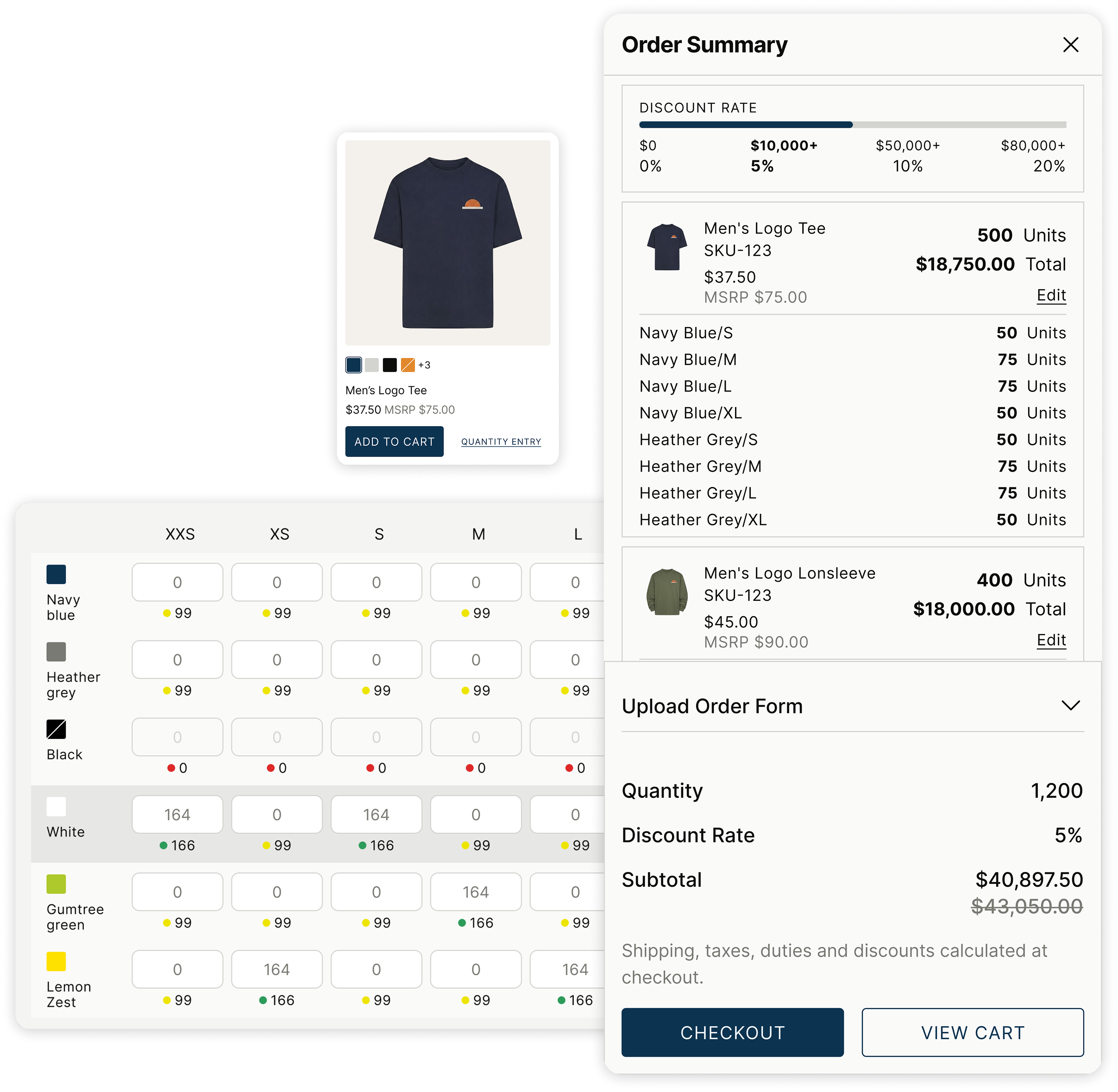

Built entirely on native Shopify Plus B2B primitives. Your dealer channel on a commerce platform — not a wholesale portal.
Seasonal wholesale hides its hard problems until you're mid-build. How a cancel date behaves when a dealer edits a booking. Where earned tiers get calculated. Whether staged drops survive checkout. We've worked through those already, against very different ERP architectures. Solstice is that thinking made reusable — the decisions arrive settled, and the platform keeps developing after you launch.
The buying year
Two seasons run at once.
For most of the year a dealer is booking one season while another ships.
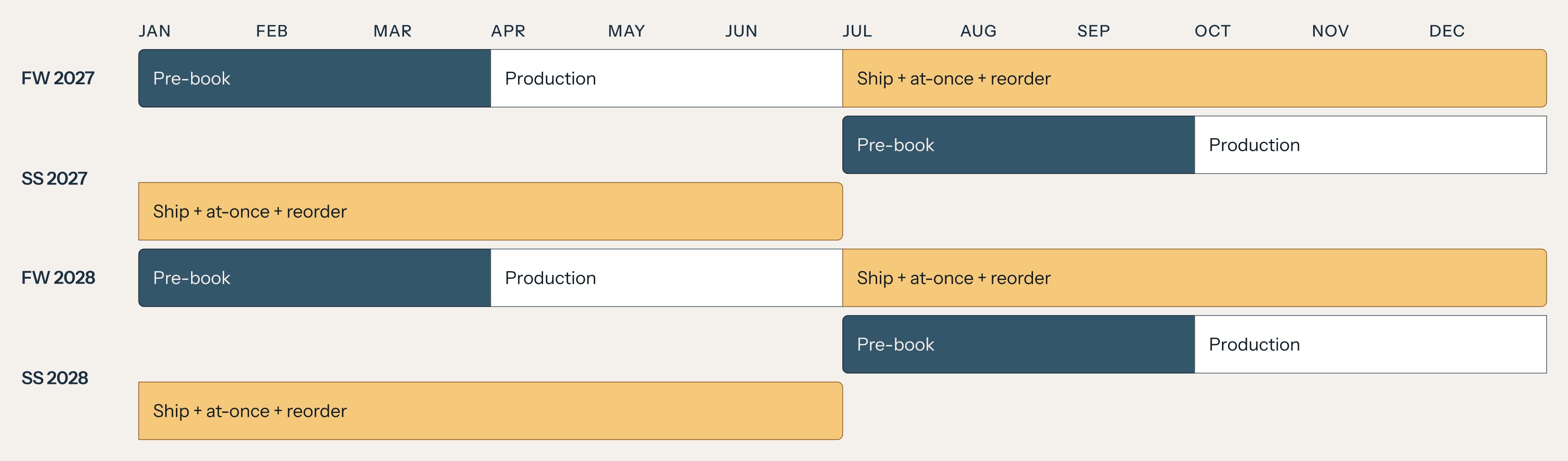

How seasonal wholesale runs today
Wholesale truth is split across four places
No single system holds the season. The team reconciles it by hand.
The gap, and what closes it
Shopify B2B is built for continuous ordering. Solstice makes it seasonal.
Distributors force this today with duplicate stores, spreadsheets and EDI, or reps keying orders by hand. Six capabilities close the gap.
|
What you do |
Shopify B2B natively |
What Solstice adds |
|---|---|---|
|
Open and close the book on a date |
Shopify B2B natively Catalogs have no open or close date |
What Solstice adds Season windows — open and close pre-book by catalogue, with cancel dates enforced |
|
Keep several bookings open, for months at a time |
Shopify B2B natively One active cart per buyer, cleared between sessions |
What Solstice adds Concurrent program carts — next season's booking and an at-once reorder sit side by side |
|
Price one SKU differently per program |
Shopify B2B natively One price and visibility at a time |
What Solstice adds Per-program pricing — the same product carries a different price, stock, and visibility in each program |
|
Split one booking across ship dates |
Shopify B2B natively One delivery intent per order |
What Solstice adds Staged delivery windows — one booking splits into dated drops |
|
Have a rep build the order with the dealer |
Shopify B2B natively Draft orders are admin-side only |
What Solstice adds Rep-assisted ordering — reps build and share draft orders, or work the same order with the dealer |
|
Carry earned status through the season |
Shopify B2B natively Nothing persists between orders |
What Solstice adds Earned program tiers — this season's volume accross all orders unlocks the next order's terms |
Why Shopify
You are not switching a portal for another.
You are standing the dealer channel on commerce infrastructure.
Capabilities
01
Season windows
You decide when the book opens, and when it closes. Open pre-book by catalogue on a date and close it on a date. Cancel dates are enforced in the system, not chased over email.
02
Concurrent program carts
One dealer. Several open orders. A dealer builds next season's booking while reordering this season's stock. Both carts stay open for as long as the window runs.
03
Per-program pricing
Same product. Different price per program. The same jacket carries a pre-book price and an at-once price. One product record, one inventory truth, different terms per program.
04
Staged delivery windows
One booking. August, September, October. A dealer splits a single booking across dated drops at checkout. The ship schedule survives into the order and into your ERP.
05
Rep-assisted ordering
Your rep and your dealer, on the same order. A rep builds an order at a trade show and shares it with the dealer to review. Or both work the same order together, in the same place.
06
Earned program tiers
This season's volume. Next season's terms. Pre-book volume earns the discount, shipping, and dating a dealer gets next season. Status carries forward instead of being rebuilt in a spreadsheet.
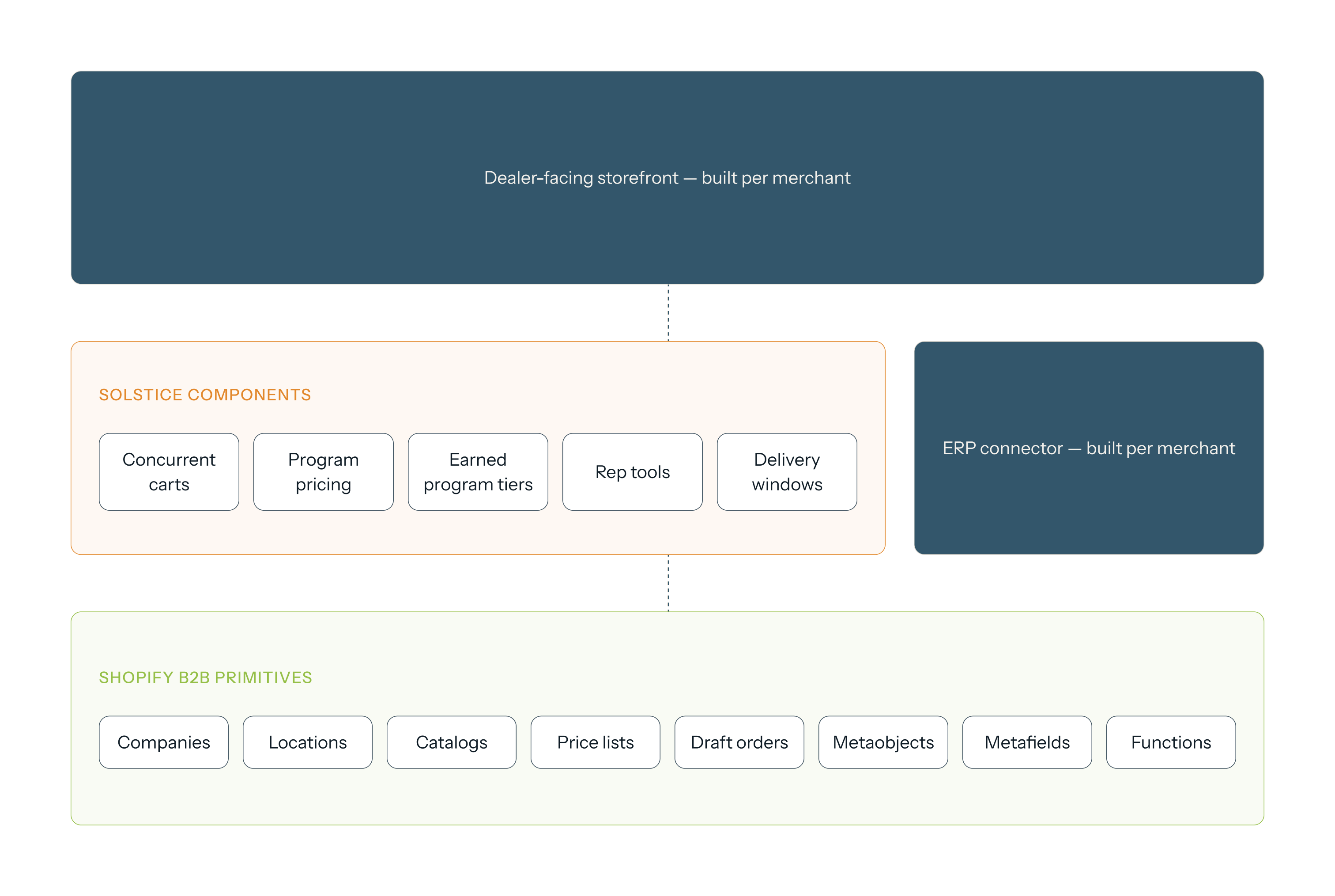

How it's built
Native, not a workaround
Solstice runs on native Shopify Plus B2B primitives — catalogs, companies and locations, price lists, payment terms, metaobjects, and Shopify Functions. Nothing is replaced or forked, so it upgrades cleanly as Shopify evolves.
Your dealer storefront and your ERP connector are built for you, against the same product every other merchant runs. One app instance, versioned and patched centrally by Molsoft.
Book a demo
Your next booking window is the deadline.
Book a demo and we'll walk the live build together. You'll see one dealer hold two open orders, priced differently, shipping on three dates — the thing one cart can't do.
FAQ
No. Most distributors who fit aren't. Adopting Shopify Plus is part of the engagement.
Yes. Solstice is built for wholesale-first businesses. DTC is available later on the same platform, and never required.
Unlimited catalogs and catalog-to-location assignment are Plus-only. Both are load-bearing for per-program pricing. Solstice does not exist below Plus.
Both are mature wholesale platforms. They handle full B2B ecommerce, merchandising, and seasonal buying well — that's not the difference. The difference is what you own. On a dedicated platform, the buying experience is the vendor's: their interface, their release schedule, their constraints. On Shopify, the dealer storefront is yours — designed, merchandised, and changed on your timeline, with the same experience your buyers already expect as consumers. Solstice adds the seasonal model natively on top: season windows, concurrent program carts, per-program pricing, staged drops. You get purpose-built seasonal behaviour without a second catalogue, a second sync, or a roadmap you don't control. And when the channel grows — retail, trade shows, closeouts, DTC — it's the same stack, not a migration.
Yes. The connector is built for your system against Solstice's stable interfaces. We have built against both a modern ERP with a PIM and a legacy system over CSV and SFTP.
Most engagements run about twenty-one weeks for a merchant new to Shopify. Three workstreams run in parallel: the Shopify platform and dealer storefront, your ERP connector and data migration, and Solstice configuration. Discovery and data audit come first, then architecture and design, then build and integration, then UAT with a pilot dealer group ordering against a live window. The full network opens on your booking date.
Usually not, entirely — and that's normal. The data audit is the first phase for a reason. We tell you what needs fixing before anything is built.
Yes. There's a working demo store, and we can walk you through it on a call.