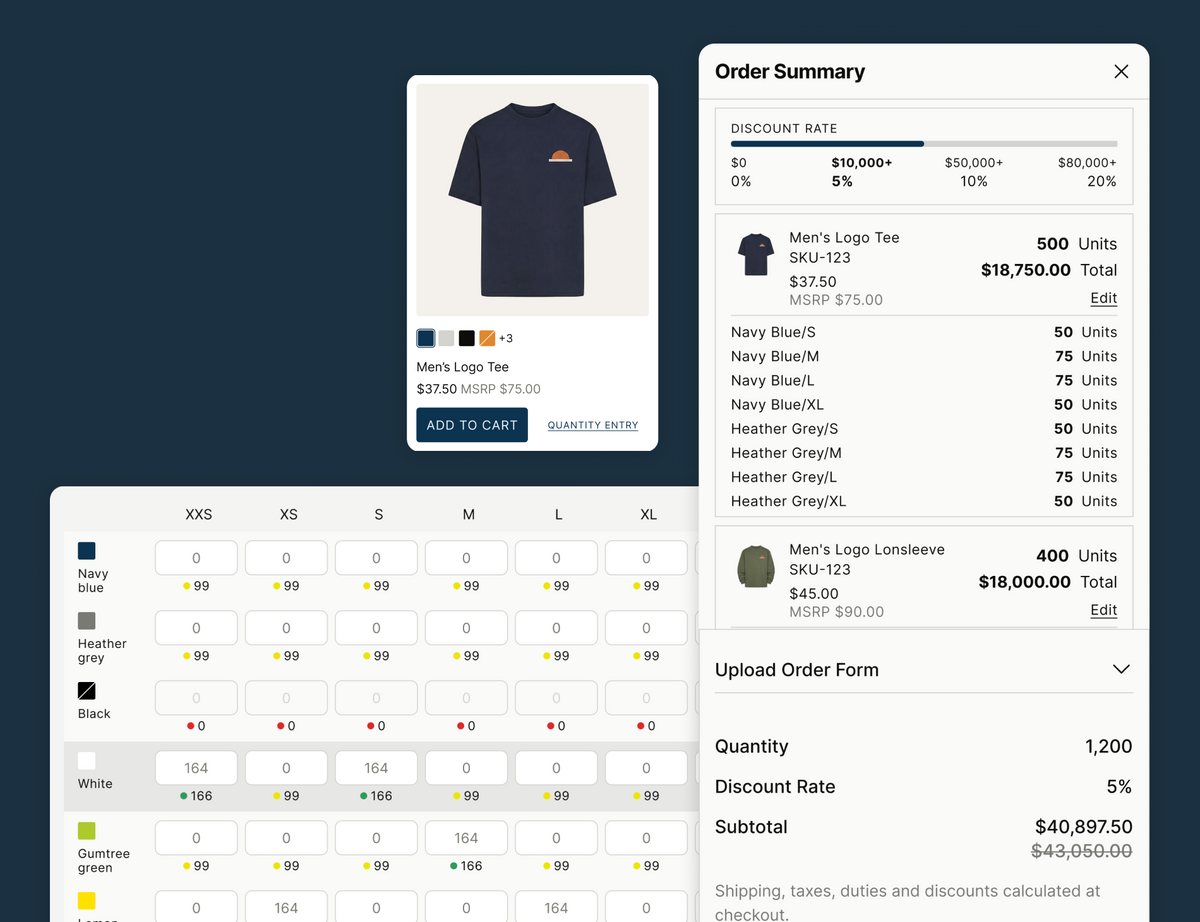
Shopify B2B has become a credible wholesale platform for a large share of merchants. On Shopify Plus, company accounts, catalogues, price lists, and net payment terms cover the core of how most wholesale relationships operate, and they do it inside the same admin that runs the retail and DTC side of the business. For a manufacturer selling a stable line to a few hundred accounts, that is often enough.
Distribution is a different animal. Outdoor and apparel distributors don't buy once against a fixed catalogue — they buy in seasons, in overlapping order types, and rarely alone. Native Shopify B2B was built around a single active cart that resolves into a single order, and that one assumption is where it stops matching how distributors actually place business.
What Native Shopify B2B Does Well
It's worth being fair to the platform before taking it apart. Company accounts model the buyer organization with its locations and contacts. Catalogues scope which products a given company or location sees. Price lists apply account-specific pricing, fixed or percentage, without cloning products. Payment terms support net 15/30/60 and due-on-receipt. Quantity rules enforce order minimums and case-pack increments at the variant level. Draft orders let staff assemble an order in the admin and send it for payment. For continuous wholesale, that stack is coherent, low-maintenance, and, importantly, keeps one inventory source of truth across wholesale and retail. None of that is the problem. The problem starts when the buying rhythm gets more complex than one cart, one order.
Where Shopify B2B Stops Short for Seasonal Distributors
Four gaps show up almost immediately when a distributor tries to run a real booking calendar on native B2B.
Persistent carts across booking seasons
A pre-book order isn't built in one sitting. A buyer opens a Spring 2027 order in the summer of 2026 and adds to it over weeks as the line firms up and allocations come in. Native Shopify treats the cart as a session-bound, single active container, not a durable, named order-in-progress a buyer returns to across a months-long booking window. Leave it long enough and the working order a rep and buyer have been assembling has nowhere stable to live.
Multiple concurrent open carts
Distributors rarely have just one order open. A buyer is often building a pre-book for next season and a fill-in (at-once) order against current stock in the same week — two orders, two delivery timelines, two sets of minimums. Native B2B gives a customer one cart. There is no native way to hold several named, parallel orders for the same account and check them out independently.
Shared carts between reps and buyers (rep-assisted ordering)
Most distributor orders are placed with a rep, not by a buyer working alone. The rep knows the line, the buyer knows the floor, and the order gets built together. Shopify splits that work across two surfaces: the buyer-facing storefront cart, and staff-side draft orders in the admin. Neither is a single shared cart that a rep and a buyer can both see and edit in real time — draft orders are an admin artifact, and staff permissions govern the admin, not a co-editable buyer cart.
Pre-book vs in-season order types
Apparel and outdoor buying runs on two modes. Pre-book (futures) orders commit months ahead against a line that isn't in the warehouse yet; in-season or at-once orders draw down live available-to-sell inventory now. They differ in inventory logic, delivery timing, and cancellation windows. Native Shopify models inventory as available-now and an order as a checkout against it. It carries no order-type distinction that changes how the cart validates against future versus current stock.
Does Shopify B2B Support Pre-Book Ordering?
Not natively. Out of the box, Shopify B2B has no dedicated pre-book or futures order type. It validates a cart against current inventory and resolves it into one order at checkout. You can approximate pieces of pre-booking with quantity rules, draft orders, and separate catalogues, but you can't natively hold a persistent, future-dated order that a buyer builds over a booking window, sits alongside an in-season order, and validates against projected availability instead of live stock. Supporting real pre-book ordering means adding that logic on top of the platform. The question then isn't whether Shopify can do it, it's how you add what's missing without breaking what already works.
The Fork: A Dedicated Wholesale Platform, or Build on Shopify
A distributor that hits these gaps has two real options, and they lead to different architectures.
The first is to run a dedicated wholesale ordering platform as the system of record for B2B. These tools are purpose-built for pre-book, line sheets, and rep workflows, so the head start is real: the seasonal and rep-assisted mechanics work on day one, with nothing to build. What you're buying, though, is an ordering portal, not a commerce platform. The vendors are niche and the roadmaps are thin; you move at the pace of one company's backlog and hand your integrations, support, and future features to a single services team.
The second is to make Shopify the commerce foundation — one system of record for catalogue, price lists, inventory, and orders — and add the seasonal and rep-assisted cart logic as an extension on native B2B. Shopify already ships the wholesale primitives: company profiles, customer-specific catalogs, price lists, and payment terms, inside the same admin and checkout that run every other channel. You extend that base instead of standing up a separate stack, and the platform carries the hosting, PCI, and upgrade load a standalone system would push onto your team. Extending it carries custom development cost, and you own the maintenance of what you build.
What that base buys you is the difference between a portal and a platform. Shopify is commerce infrastructure under continuous investment, it outlives any single wholesale vendor. Your dealers buy the way they already shop as consumers, so self-service replaces rep-keyed orders and frees reps to sell. It goes where your reps go: trade shows, dealer visits, showrooms, and pop-ups all run on the same native retail surface, where a portal has none. And it comes with an ecosystem instead of a roadmap — payments, tax, shipping, ERP connectors, and agencies by the thousand, competing for your business, versus one vendor's queue. The optionality sits on top of all of it: closeouts direct, DTC, or retail, later, on the same stack — available if you ever want them, required by none of this.
For a seasonal distributor moving off a legacy ERP or wholesale platform, the portal buys a faster launch on a foundation you don't control and can't extend past what one vendor ships. Building on Shopify carries the up-front cost of the extension, but it compounds: a platform that keeps investing, an ecosystem that keeps competing, and one system of record as the catalogue grows. Over a few seasons, that's worth more than a faster start on a tool that can only ever be a tool. That's the path we took.
What We Built: Solstice
Solstice is our solution for that second path, packaged. It combines Shopify Plus, native Shopify B2B, Shopify POS, and a custom cart extension, and the design rule is that the extension adds what distributors need without replacing anything native. Company accounts, catalogues, price lists, payment terms, and inventory stay exactly where Shopify keeps them. The extension layers the seasonal and rep-assisted behaviour on top:
-
Named, persistent carts that survive across a booking window, stored against the company account rather than a session, so a buyer resumes a Spring order weeks later exactly where they left it.
-
Multiple concurrent carts per account, each tagged with an order type, so a pre-book and an at-once order stay separate and check out on their own timelines.
-
A shared cart, a rep and a buyer both work in, so rep-assisted ordering happens in one place instead of being reconstructed from a draft order.
-
Order-type logic that validates a pre-book against projected availability and an in-season order against live inventory.
The build doesn't start with code. It starts with a scoping step we run before any development: mapping the buyer's booking calendar — pre-book windows, in-season windows, and delivery drops — to the order types the cart has to support. If the cart model doesn't match the real buying rhythm, no amount of custom development saves it, so that mapping is the gate everything else runs through.
The Takeaway
Native Shopify B2B isn't the wrong platform for seasonal distributors, it's the right foundation with a few distribution-shaped gaps. The distinction that matters is whether you fill those gaps by bolting on a second system or by extending the one you already trust with your catalogue and inventory. For distributors already committed to Shopify, extending it keeps the business on a single source of truth through every booking season.
If you're running a booking calendar on Shopify B2B and feeling where it stops, see Solstice in action.