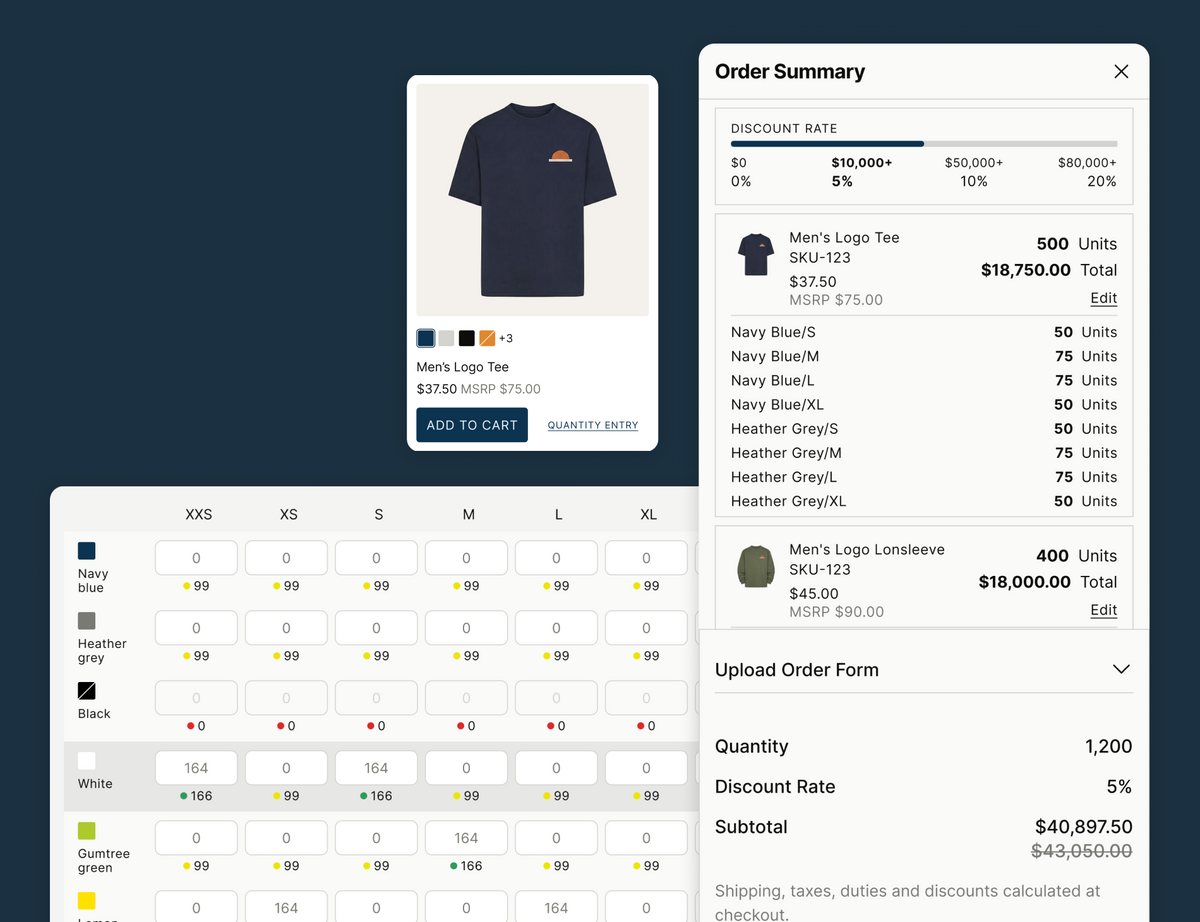
Most ecommerce carts are built around a single assumption: one shopper, one basket, one checkout, one shipment. That assumption holds for retail. It breaks the moment a distributor's buyer sits down to place an order, because wholesale buying doesn't run on one calendar; it runs on two at once. A Shopify B2B cart serving outdoor, apparel, or footwear distribution has to hold a pre-book order for next season and an at-once order for this week's shelf gaps, often in the same account, on the same afternoon.
That collision is the whole problem. Pre-book and in-season aren't two settings on one order; they're two ordering models with different inventory logic, different minimums, and different delivery timing, and a cart designed for a single transaction has nowhere to put the second one.
Pre-book vs at-once ordering, defined (the terms buyers actually use)
These definitions are the vocabulary the rest of the workflow depends on, so it's worth being precise about them.
Pre-book — also called futures, advance, or pre-season ordering — is a commitment made weeks or months before goods are physically available. A buyer reviews a seasonal catalogue or line sheet, commits quantities against a brand's projected production, and accepts a delivery window rather than a ship-tomorrow date. Pre-book is a distributor's practice of reserving next season's allocation before it's manufactured.
At-once — also called in-season, immediate, fill-in, or re-order — is the opposite: an order placed against inventory that exists right now. The buyer is checking live availability and expecting near-immediate fulfillment to refill a fast-selling SKU, cover a shelf gap, or chase demand mid-season.
The hinge between them is ATS — available-to-sell: the quantity a distributor can actually commit at a given moment, calculated as on-hand inventory minus what's already allocated, plus (for pre-book) what's forecast against a future production run. At-once orders draw down the current ATS. Pre-book orders draw down future ATS. Two order types, two inventory pools, one buyer.
A few more terms function as hard constraints the cart has to respect: delivery windows (the start-ship and complete-ship dates a pre-book order is scheduled into), cancel dates (the point after which an unshipped pre-book line is void), and order minimums, typically a larger opening-order minimum for pre-book and a smaller re-order minimum for fill-ins.
What a pre-book order requires from the cart
A pre-book order is not a fast transaction; it's a persistent one. The cart has to stay open across a booking window that can run for weeks while a buyer builds an order, brand by brand and style by style, revisiting it as the seasonal catalogue fills in. A cart that clears on session end, or expires after a day, loses the entire commitment.
It also has to carry the structure that a retail basket never needs. A single pre-book order routinely splits into multiple delivery windows: spring styles ship in February, summer styles in April, meaning one cart holds line items scheduled to different ship dates and governed by different cancel dates. Opening-order minimums apply per brand and sometimes per delivery, not to the order as a whole, so the cart has to validate quantities against each threshold independently. And every quantity is a commitment against forecast ATS rather than on-hand stock, so the availability logic in the cart is reading a production projection rather than a warehouse count.
Sketch it, and you get a cart that behaves like a scheduling document: open for weeks, segmented by ship window, minimum-checked per brand, and reconciled against inventory that doesn't physically exist yet.
What an at-once (in-season) order requires — and why it runs at the same time
At once, ordering asks for almost the reverse. The cart has to check live ATS against on-hand inventory in real time, reflect what's actually in the warehouse this minute, and move to fulfillment immediately once submitted. Minimums are usually lower, a re-order threshold rather than an opening-order commitment, because the buyer is topping up, not committing to a season.
Here's the part standard tooling misses: at-once and pre-book run concurrently. A distributor's buyer doesn't finish next season's pre-book, close it, and only then start placing fill-ins.
Mid-season, both are live, a pre-book cart for the upcoming season sits open while at-once re-orders for the current season go through the same account, under the same login, against the same catalogue. The buyer needs two carts in flight at once, each with its own inventory pool, minimums, and delivery logic, and must keep them from contaminating each other.
Why a standard Shopify B2B cart can't hold both seasons out of the box
Native B2B on Shopify covers a real amount of wholesale groundwork: company accounts with multiple buyers, catalogues, and price lists scoped per customer, payment terms, and buyer-level permissions. For a straightforward wholesale re-order, that's often enough on its own.
Two-season buying is where the native cart model reaches its edge. Standard checkout is built around a single active cart per session, resulting in a single ship date and destination at submission. It has no concept of a cart that stays open for weeks, no concept of a second concurrent cart representing a different season, and no built-in logic for splitting a single order across delivery windows with independent cancel dates. Order minimums are enforced against the cart total rather than per-brand or per-delivery. And availability checks read on-hand inventory, not the forecast ATS pool, a pre-book order needs to commit against.
Closing that gap means reaching past the defaults. Checkout extensibility and Shopify Functions can carry custom validation — enforcing per-delivery minimums, for instance — and cart transforms can reshape line items, but the persistence, concurrency, and forecast-ATS logic that two-season buying needs isn't something you configure; it's something built on top of the native B2B foundation.
The fork: two ways distributors reconcile two seasons
Faced with two-season buying, a distributor's team generally weighs two architectural paths, each with real trade-offs.
Path A: Separate the seasons into distinct flows
Pre-book and at-once live as two different ordering experiences: separate catalogues, separate carts, separate storefronts, kept apart by design.
The advantage is simplicity: each flow models a single, clean ordering type, and the two can't contaminate each other.
The cost is fragmentation: a buyer's commitments scatter across two places, minimum logic is duplicated and maintained twice, and no single view shows everything a company account has open across in-season and pre-season.
Two storefronts are the cleanest separation and the most expensive to own. The distributor now runs two of everything: two themes and codebases, two app stacks and subscriptions, and every ERP/PIM/OMS integration wired and regression-tested twice. Day-to-day operational load roughly doubles — catalogue updates, content entry, promo setup, QA, and support each land in two places instead of one — which is real recurring time and headcount, not a one-time build cost. Total cost of ownership climbs to match: a second Shopify Plus store fee, duplicated app licensing, and the standing engineering time to keep two integration surfaces in sync rather than one.
Path B: One account, concurrent persistent carts
Both order types live under the same company account, with the cart layer extended to hold two carts at once, persist them across the booking window, and apply per-delivery minimums and season-specific ATS to each. The advantage is a unified buyer experience that matches how buyers actually work — one login, both seasons, one running picture. The cost is built complexity: this is a custom cart architecture layered on native B2B, not a setting, and it carries the maintenance that any custom extension does.
The choice usually comes down to how entangled the two seasons are for a given distributor's buyers. When pre-book and at-once are genuinely separate motions handled by different people at different times, Path A's simplicity can be enough. When the same buyer works both seasons in the same session, the norm in outdoor and apparel distribution, the fragmentation of Path A becomes the daily friction, and the concurrent-cart model earns its complexity.
Why two-season buying is a cart problem, not a checkout problem
The two-season problem looks, at first, like a checkout problem, as if the fix were a better button or an extra field. It isn't. It's a cart data-model problem: pre-book and at-once ask a cart to be persistent, concurrent, segmented by delivery window, and reconciled against two different inventory pools simultaneously. A cart built for a single retail transaction can't represent that, no matter how the checkout is styled. For distributors moving wholesale onto Shopify, the useful question isn't whether the platform can take an order; it plainly can, but whether the cart can hold two buying seasons at once without forcing buyers to pretend they only have one.