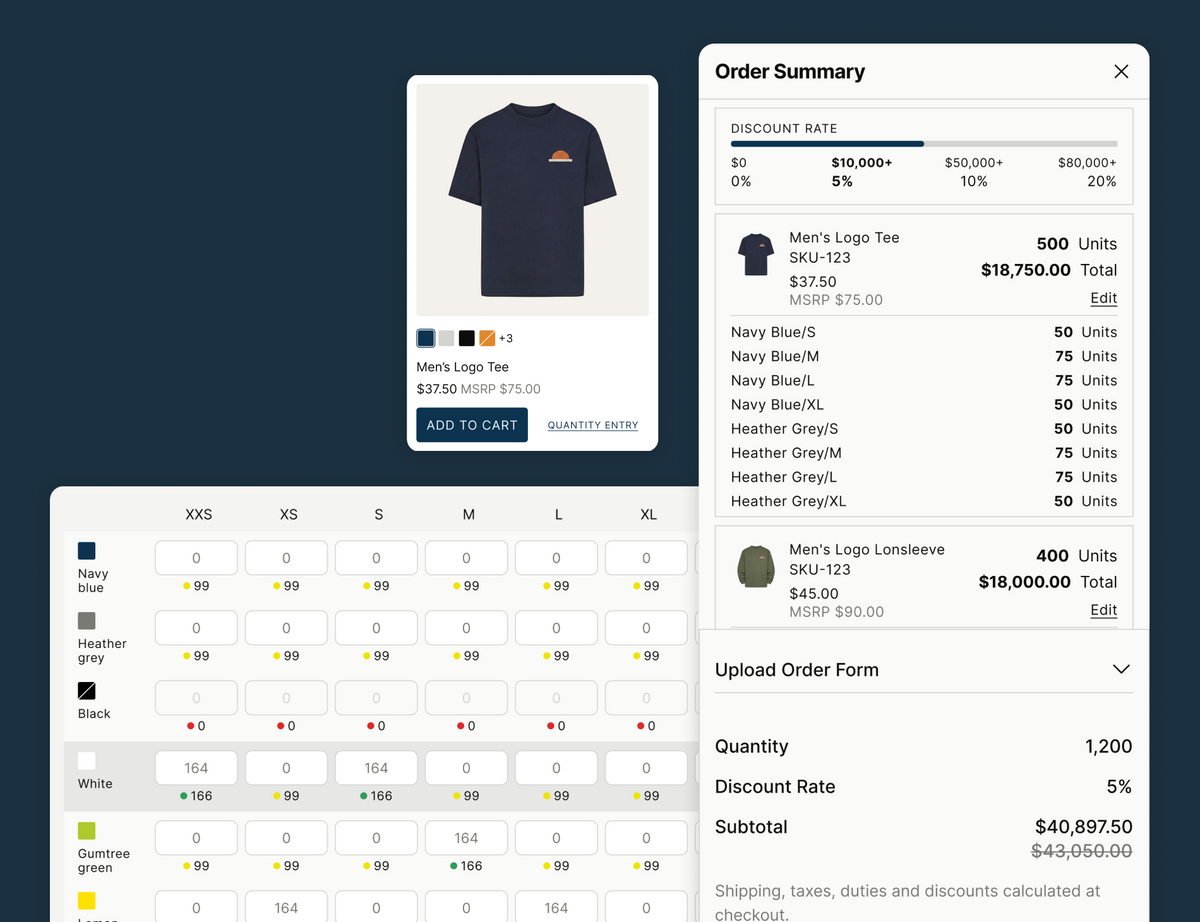
Across three days on the Outdoor Retailer floor, the distributor conversations kept converging on the same root problem: the commerce platforms these businesses run were built for a retail buyer placing one order today, not a wholesale buyer working two or three booking seasons at once. The specific complaints varied by category — footwear, apparel, hardgoods — but the underlying gap in distributor ecommerce was consistent, and it maps directly to how wholesale buying differs from the direct-to-consumer model most platforms optimize for.
We went in expecting to talk about migrations. We spent most of the time talking about carts.
The floor, and who we talked to
Outdoor Retailer ran August 19–21 in Minneapolis, Minnesota. Over those three days we spoke with more than 50 attendees, a mix of manufacturers and distributors of outdoor gear and apparel, and nearly every conversation came back to how they run seasonal ordering today.
What made the pattern credible wasn't any single conversation. It was hearing the same three constraints described, in different words, by companies who had never met each other and ran completely different catalogues.
What distributor ecommerce demands that retail ecommerce doesn't
A retail storefront optimizes for one motion: a shopper arrives, fills a cart, checks out, leaves. Wholesale distribution runs on a different clock. Buyers commit to pre-book orders months ahead of a season, layer in-season fill-ins on top, and often work several open orders at once across delivery windows. The order isn't a moment — it's a relationship that stays open for weeks. Most commerce platforms, Shopify's native B2B included in its default configuration, model the buyer as a single account placing a single order. That assumption is where the pain starts, and it showed up on the floor in three consistent forms.
Pain point 1: Next season's pre-book gets tangled up with this season's reorders
The most common frustration was about timing. A buyer working on next season's pre-book doesn't place it in one sitting. They build it over weeks, adding styles and adjusting quantities as the season comes into focus. Meanwhile, they're still reordering what's selling right now. Distributors told us their online ordering can't keep those two apart. Either the buyer loses the pre-book work they'd started, or both land in the same order and someone on the distributor's team has to split them out by hand.
One established outdoor-gear brand put it plainly: keeping orders open through the full ordering period is a hurdle they still haven't solved with their current tools.
None of them described this as a missing feature. They described it as the way their buyers have always bought, and something their online ordering was never set up to handle.
Pain point 2: Reps and buyers can't work on the same order
The second pattern was about how orders actually come together. In distribution, an order is rarely built by one person. A rep sits down with the store buyer, at a show, in the shop or on a call, and builds it with them or for them. Then the buyer needs time to review it, change quantities and sign off. Distributors told us there's no single place where both sides see the same order. So the rep sends a spreadsheet, the buyer marks it up and emails it back, and someone in customer service keys in the final version. Every change is another email or phone call, and another chance for a mistake.
This came up in nearly as many conversations as the pre-book problem.
This is what we call rep-assisted commerce: it's how most wholesale orders get made, not an exception to the normal way of buying online.
Pain point 3: Line sheets that are out of date the day they're sent
The third pattern was the easiest to picture. By our count, more than half of the distributors we spoke with still run the season on spreadsheets and email. They rebuild a line sheet every season and send it to buyers as a file. The moment stock moves, the line sheet is wrong. Buyers order product that's already spoken for, and the distributor's team is left fixing orders after the fact.
The larger operations had moved to a separate wholesale ordering site, but it lived apart from their main website. That meant keeping products, prices and stock up to date in two places. It added work for staff and brought back the same mismatches they were trying to get away from. A line sheet that pulls from the same live products, prices and stock as the website removes that double work entirely.
The real decision: bolt-on wholesale platform, or build on Shopify B2B?
Underneath every one of these conversations was the same fork, and it's worth stating plainly because most distributors haven't framed it as a choice yet.
The first path is a bolt-on wholesale platform layered onto or beside the existing store. It's faster to stand up and handles the season well out of the box. The trade-off is a second system to maintain: a separate catalogue that has to sync back to inventory and pricing, another integration in the stack, and a customer experience that lives apart from the brand's storefront. The drift and reconciliation work never fully goes away — it moves.
The second path is to build on Shopify B2B — company accounts, catalogues, price lists, and payment terms as the native foundation — and extend it where the seasonal and rep-assisted gaps are, rather than replacing it. This is the approach behind Solstice, our Shopify seasonal wholesale accelerator. It adds concurrent program carts, so a dealer builds next season's booking and an at-once reorder side by side. Season windows open and close pre-book by catalogue, with cancel dates enforced. Rep-assisted ordering lets reps build and share draft orders for a dealer, or work the same order together. Per-program pricing, staged delivery windows, and earned program tiers cover the rest of the seasonal calendar.
One catalogue, published once, with one connector to the ERP. The trade-off is honest too: the seasonal logic is already built, but the dealer storefront and ERP connector are built per merchant and configured to your actual buying calendar. It's a project, not a switch you flip on day one.
Where this leaves distributors heading into next season
Seasonal, rep-assisted, catalogue-connected buying is a different operating model than retail checkout, and the gaps we heard on the floor are specific, consistent, and solvable without abandoning Shopify. Spring/Summer pre-book opens in January. Scoping takes about 21 weeks. The decision is this fall.
If your team is hitting the same walls: pre-books that get mixed up with reorders, orders bouncing between reps and buyers by email, line sheets that are wrong the day you send them, that's exactly the ground Solstice was built to cover. Have a look at Solstice and book a demo for a walk-through.